
The 2008 Saif Ghobash Banipal Prize for Arabic Literary Translation

The Award Ceremony
and
The Sebald Lecture on the Art of Literary Translation
took place on
29 September 2008
in the
The Queen Elizabeth Hall
South Bank Centre
London SE1
Readings by the winning translators
from their translations
Paula Johnson - Administrator of the translation prizes -
presents reading by the winning translators
Presentation of the Translation Prizes
by
Sir Peter Stothard
Editor, Times Literary Supplement
Sir Peter Stodhard and Fady Joudah chatting after the award ceremony
followed by
The 2008 Sebald Lecture
on the Art of
Literary Translation
given by
Louis de Bernières
on
A Day Out for Mehmet Erbil
The evening was hosted by
The British Centre for Literary Translation,
The Arts Council and
the Society of Authors
The 2008 Winner
Judges’ Announcement
Runner-up
Commended
The 2008 winner

Fady Joudah at the awards ceremony
In announcing the 2008 Award, the Trustees pay tribute to the author of the winning translation, Mahmoud Darwish, who tragically passed away on 9 August.
The 2008 Prize has been awarded to Fady Joudah for his translation of Mahmoud Darwish’s poetry collections in The Butterfly’s Burden, published in a bilingual edition by Bloodaxe Books in the UK, and by Copper Canyon Press in the USA, the latter being short-listed earlier in 2008 for PEN America’s poetry in translation award.  On hearing the news of the award, Fady Joudah said: “I am stunned with joy. I had no idea that I was up for the translation prize. Translating Darwish’s poetry was a dream of beauty, of art, with the glimmer that art will lead to cultural and mutual respect among peoples and in making the translations I focused as much on the strange in the poems as on the familiar and the universal.”
This year’s judges were literary translator Marilyn Booth, author Aamer Hussein and Bloomsbury commissioning editor Bill Swainson, with Roger Allen chair of judges for the Banipal Trust.
Download pdf of press release
back to top
Judges' Announcement
Speaking for the judges, Roger Allen said: “Following on from the precedents of the past two years of the translation-prize competition, this year’s submissions were overwhelmingly in fictional form, and specifically novels. In spite of that however and the fact that the previous two winners of the prize had been translations of novels, it was the unanimous view of this year’s jury that the prize this year should be awarded to a bilingual anthology of poetry.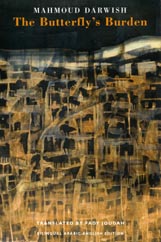 “Mahmoud Darwish is, needless to say, in no need of introduction as an author, in that he has long been acknowledged as one of the two or three most prominent poets in today’s Arab world, as well as internationally, and has been for over half a century the predominant poetic voice of the Palestinian people. While his poetry has already been translated and anthologised widely, this bilingual anthology, The Butterfly’s Burden, compiled and translated by Fady Joudah, brings together three more recent collections, [The Stranger’s Bed] (1998), the lengthy poem, [State of Siege], and [Don’t Apologize for What You’ve Done] (2003). The translator’s sensitivity to the nuances and music of the original texts is already evident in the way in which the poetry is introduced and the translation process discussed in the Preface. Darwish is there described as ‘a songmaker whose vocabulary is accessible but whose mystery is not bashful.’ The resulting versions in English replicate, deliberately so, the structures of the original poems that parallel them on the opposite page, and yet they can be read in their English forms as wonderful transfers of the images and music of the Arabic poems. It goes without saying that this is a major achievement. Darwish’s recent contributions to contemporary Arabic poetry and to the literary tradition of his Palestinian people – most especially the siege poem emerging from the Second Intifada – are here made available in a carefully produced and beautifully translated volume.
To buy The Butterfly’s Burden online in the UK/Europe, click here
To read a review of The Butterfly’s Burden in The Guardian newspaper , click here
To buy The Butterfly’s Burden online in the USA, click here
• • • • •
back to top
Runner-up “The runner-up is Ghassan Nasr’s translation of the late Jabra Ibrahim Jabra’s last novel, The Journals of Sarab Affan, published by Syracuse University Press. It is the work of another Palestinian author who was poet, novelist, art and music critic, and himself a superb translator of English literature and criticism into Arabic (not least the tragedies and sonnets of Shakespeare). Following a favourite pattern of this novelist, the work is narrated through the voices of two contrasting narrator-characters, one a prominent novelist and other a woman who falls in love with him. As is to be expected with the writings of this poet-novelist, the Arabic text is couched in language of exquisite beauty, and Ghassan Nasr succeeds admirably in transferring the nuances of the original to an English version that is a pleasure to read.’
To read a review in Banipal 33 of The Journals of Sarab Affan click here
To purchase a copy of The Journals of Sarab Affan in the UK, click here
For more information about The Journals of Sarab Affan and/or online ordering in the USA, click here
back to top
Commended A third submission won commendation – the translation by Nancy Roberts of Salwa Bakr’s The Man from Bashmour, published by The American University in Cairo Press. The jury was deeply impressed by this submission, describing it as a “courageous novelistic exploration of Egypt’s complex relationship with its Christian (Coptic) community during the 9th century AD. The Man from Bashmour is a historical novel that clearly involved its author in a large amount of research into the life of the community, the language of its liturgies, and the history of its status within the Muslim communities of Egypt. The text uses highly complex levels of discourse, and the translation project has therefore been a significant challenge, one that has been met with great success by the translator. This novel is an important contribution to the continuing tradition of historical fiction-writing in Arabic, especially within the Egyptian context, and its translation into English in such an accomplished fashion is to be welcomed.”
To preview The Man from Bashmour and/or purchase a copy online in the UK, click here
For more information about The Man from Bashmour and the online US ordering link, click here
Commenting on the results, Marilyn Booth said that the high quality of submissions and the range of publishers represented in this year's Banipal Prize competition were evidence that contemporary Arabic literature was enjoying growing international interest and the attention of skilled translators. “Joudah’s brilliant translation and presentation of recent works by the renowned poet Mahmoud Darwish, she added, “allows the reader of English to savour the solid and carefully crafted building blocks of Darwish’s bold and delicate imagery and the echoes of his sound patterns. Darwish has long been an eloquent voice for Palestinian identity, aspirations, and rights, but his poetry is never reducible to politics, and this volume above all communicates Darwish’s mighty artistic presence at this utterly mature period of his poetic career.”
Marilyn Booth went on to say that the runner-up, Ghassan Nasr, in his translation of Jabra’s novel “captures beautifully the intense delicacy of human intimacy that this leading writer’s fiction traces”, while the commended translation by Nancy Roberts of Salwa Bakr’s historical novel, “itself a tour de force in its imaginative retracing of a turning point in Egypt’s history and one that carries great political sensitivity in contemporary circumstances, is a translation that conveys the double language of a historical moment and a contemporary resonance, with its careful use of archaisms and its respect for Bakr’s intensely historical, archival language.”
In conclusion, the jury expressly noted that “the quality of the majority of submissions to this year’s competition was extremely high, an indication of the ever-increasing skills exhibited by the still relatively small number of translators who are devoting themselves to the transfer of the treasures of the modern Arabic literary tradition to an English readership.”
back to top